Friday, July 28, 2017

Uncharted 4 : Systemic Combat


In his GDC talk, Matthew Gallant (combat designer at Naughty Dog) discusses how for Uncharted 4 the combat team reevaluated how they approached combat design. Instead of tightly scripted encounters, the game moved towards a more systemic approach to NPC AI behavior. Today I'd like to examine the player experience that flows through from this approach and how it relates to the underlying system.

COMBAT ROLES
  • Inspired by Pacman's Inky, Blinky and Pinky, Uncharted 4 has 3 combat roles in the game :

    1. Engagers - Close in on player position.
    2. Ambushers - Pick an ambush point and hold their ground. As the player gets closer, they pop out and surprise players adding tension and making the place feel fuller.
    3. Defenders - Assigned to hard points where they hold their ground and fire. This gives the player focus points to navigate towards.
    4.  

  • The assignment of these roles are systemic and based on a set of global parameters.


  • But ofcourse the player is unaware of this internal system. So how does this system translate into a player experience?
  • The player's mental model of a combat arena (when in an active state of combat, i.e., not sneaking) is quite simply an internal priority list for who to fire at. Below are some of the factors based on which this prioritization occurs :
  1. Damage dealing ability
  2. Distance from player
  3. Jeopardy to current position
  4. Maneuverability to next cover position or vantage point
  • The key to the nature of these global params is to accommodate for the ability to break the player's mental model in incremental steps.
  • For example, the engager count and time delay to replace an engager result in an NPC dynamically becoming an engager when an NPC is killed. This essentially invalidates the player's established next steps but in a manner that she can clearly react to.
  • The params also need to be constructed in a manner that the player is incapable of predicting the reaction of the system to her actions.
  • Therefore, the resulting experience from this system is one of constant re-prioritization where the player is constantly reacting to systemic changes.

DIFFERENTIATION FROM THE LAST OF US
  • In TLOU, due to the instant death nature of contact with clickers the player is expected to formulate a strategy for as large a window as time as possible.
  • From that point onward, gameplay revolves around deft execution of that strategy through timing.
  • The player is expected to react at points where she fails to execute on a given strategy or when the strategy has failed to accommodate certain aspects of the layout.
  • However, the result is to scramble to safety and reevaluate. In this manner player's are much more constrained than in Uncharted, in two ways :
  1. In UC planning is only incentivized not enforced. 
  2. In TLOU, reactions are high pressure break points from game flow. In UC, the player is in a constant reactionary state.
  • However, the tight constraints in TLOU, implies that situations where the player is pressured into breaking free from these constraints are meaningfully differentiated and create a tension that Uncharted's systemic combat can never achieve.
SYSTEMIC AUTHORSHIP - ILLUSION OF AGENCY
  • In the talk, Gallant also makes the assertion that it was important to the design team to be able to continue to exert a controllable degree of authorship over each encounter. I'd like to examine how systems can accommodate for such tight authorship when required.
  • The solution is heavily dependent on level design based indirect control. I think it is safe to say the more vast the encounter space, the harder it is to author.
  • For example, consider the following encounter (Reunion) :

  • From the player's perspective this may seem like a pretty open space at first glance. However, there are really only two arteries that run through this space. It roughly corresponds to the following layout :
  • The furthest defender is an RPG wielding bad ass so he's pretty much your directional indicator. The natural behavior from this layout is to use one of the first two cover points to get a better layout of the land.
 
  • At this stage, the player is forced to choose one of the two arteries that cut through the level. However, the game employs a few tricks to force the player into the decision it wants her to make, i.e., select the elevated path :
  1. Each of the cover points are destructible forcing the player to shuffle right, i.e. towards the "right" path.
  2. Incoming engagers and defenders reinforce the decision to go right to gain additional cover.
  3. The nature of the layout is sufficiently clear for the player to decipher vantage ability.
  • Once the player has climbed onto the ledges, the game is now poised to counter the player with tailored scenarios made possible systemically. For example :
    • The player hanging on the ledge triggers an ambusher setting the player up for an over the ledge gun shot.
   
    • Similarly, the player jumping thresholds triggers ambushers on a different vertical axes as shown below. Additionally, killing the ambusher allows the defenders to be reassigned to engagers further pressing the player to utilize his vertical vantage.


Saturday, July 22, 2017

Destiny : Through the Lens of a Single Player Game


In his GDC talk, Justin Truman from Bungie mentions that one of the goals for Destiny was to make a multiplayer game that had all the juice of a single player FPS. In this blog, I'd like to look at the moment to moment gameplay that creates this juice. Zooming this lens out a bit more, I'd also like to look at how Destiny 's features reflect or contradict some of the larger trends in the FPS genre. These trends are explained brilliantly in Justin's Pierce's Gamasutra blog here.

THE ZEITGEIST OF FPS

In his blog, Justin argues that the paradigm shift from PC to console and therefore mouse based input to controller based input is the root cause for changes in minute to minute gameplay.


                Higher Range of Motion                                   Lower Range of Motion


Essentially because the range of allowed input is greatly reduced when moving from free form mouse movement to thumb based joystick rotation, games slow down combat so that it's easier to track targets using a controller. This then necessitates mechanics such as sprinting to speed up non combat situations, aim down insight for targeting assistance, and OP melee attacks to counterbalance being flanked in close range by charging enemies. Now digression aside let's return to Destiny.

DESIGN PILLAR - COMBAT TENSION

One of the cornerstones of Destiny's combat system is a sense of tension. This tension is largely elicited by keeping the player on her feet at all times. It's neither enjoyable nor possible to be successful in a Destiny encounter if you're camped in a location trying to take out enemies one by one. The indirect control over player motion is governed largely from the relationship between player and enemy attack ranges.

PLAYER vs RANGED

Both the player and enemies have ranged and melee attacks. However, the player will spend most of her time in ranged vs ranged combat. As in most ranged vs ranged combat, the player selects a suitable cover point and alternates between firing and retreating into cover to recover health.


Player vs Ranged Combat - Default Play Style

PLAYER VS MELEE

By establishing a default play style mode of sorts, the game then puts itself in situations where it can surprise players by breaking pattern. Melee attackers are used more as a tool to break player flow. Therefore, by simply modelling of context, the game greatly magnifies perceived danger. In most case, the player could simply hold their ground and execute a melee attack (which is typically high impact as Justin Pierce predicts). However, in most cases incoming melee attackers forces player backwards (out of cover) and requires her to reorient to the situation.


Player vs Melee - A Magnification Tool

EMERGENT COMPLEXITY

Establishing ranged and melee enemies in this way also allows the game to establish the difficulty of an encounter to be greater than the sum of it's parts. For example, placing an enemy with high damage ranged ability with waves of melee attackers forces players out of cover periodically exposing them to greater damage risk from the ranged attacker. This forces the player to think about enemy prioritization in terms of distance, impact to cover etc.


Two Ranged and One Melee Enemy 

Likewise, this perceived risk can also be mitigated by enemy zoning. Flanking players can create a heightened sense of danger and challenge. However, even though the perception is that she is fighting the enemy on all fronts really the danger is only from one set of enemies at a time because they have been demarcated to certain bounds.

TRIANGULARITY

The ranged - melee interaction systems also scales to different play styles based on risk taking appetite. Slower or weaker enemies can be slowly chipped away from behind cover or rushed and meleed aggressively.


Goblin - A Slower Moving Enemy

Other instances of high risk, high reward systems are heavy ammo, blaster and super attack systems. While almost all of the player's attacks are hitscan based, these are noticeably projectiles. To maximize probability of success this needs the player to break cover, get to a suitably close location, and then execute the attacks.


INCENTIVIZING RISK

Establishing high risk, high reward systems however only establishes support for different play styles. To encourage certain types of play behavior separate mechanics are required. Essentially the player needs an escape mechanism, when a high risk plan looks like it may go awry. In Destiny, the double aerial jump serves this purpose (which also serves as an innovative faster traversal mechanism as Justin identifies in his blog).


Double Jumping - An Exit Route

WEAPONS GALORE

Another means through which Destiny supports different play styles is by providing an arsenal of weapon that are meaningfully differentiated. Additionally the game is balanced to ensure that dominant strategy does not emerge through the selection of certain weapon types. This type of differentiation allows the player to parse through the arsenal based on desire rather than optimizing utility. This also allows the player to seek specific weaponry and results in enhanced satisfaction when it is found.


COVER SYSTEM

And finally, another system that encourages risk taking behavior and free form movement is cover. Cover is non sticky so the player's transitioning through cover is uninterrupted. Conversely there is uncertainty involved in whether cover is fully blocking attack for the same reason. The level design is such that cover is always accessible within a few seconds of movement which means players are freely moving through locations as opposed to mastering location maps. This also allows the player a basis to prioritize enemies, i.e., enemies that invalidate cover take higher priority. Emergent strategies from this system are shuffling through cover to surprise enemies from the side. 


Sunday, April 2, 2017

Heavy yet Responsive : The Combat of God of War


COMBAT STYLE
  • In general, God of War is a responsive combat system. Yet, Kratos is certainly not a nimble character. His attacks tend to feel heavy.
  • This coexistence of heaviness and responsiveness is made possible through short attack sequences. Unlike a game like Batman : Arkham, Kratos rarely strings together rapid attacks. Each individual combo is usually no more than 3 attacks.
  • Furthermore, the attack sequences tend to be fairly diversified. Therefore, the element of engagement lies not in stringing combos but instead feeling a sense of autonomy as the player executes diverse moves.
  • Overall it seems like the combat style is meant to cater to a mid core audience, who aren't necessarily playing for a deep combat experience.
ATTACK CANCELLATION
  • Another key feature in combat is the ability to cancel an attack mid combo.
  • The feature creates a much stronger sense of timing as it allows players to simultaneously watch for incoming enemy attacks while in mid attack.
  • However, there is an interesting system of triangular, high risk - high reward that emerges from the cancellation feature.
  • Certain combos are simply not cancellable while most others remove the ability to cancel just before the last powerful strike in the combo sequence.

                                                    (L1 + Square) is not cancellable


    (Square, Square, Triangle) is cancellable only before the final triangle.
     
  • This system puts the player in a mindset where he is surveying the battle scene to see whether it is safe to execute non cancellable combos.
ANIMATION AND COMBAT 
  • The combat system in God of War is primarily melee - melee. A crux of the engagement of the combat system lies in the player determining windows when he can attack, when he should block and when he should roll away to dodge attacks.
  • Given this system animation takes on a role beyond simple visual aesthetics. The animation in the interval between attack initiate and attack hit, serves as feedback for the player to determine and time his course of action.

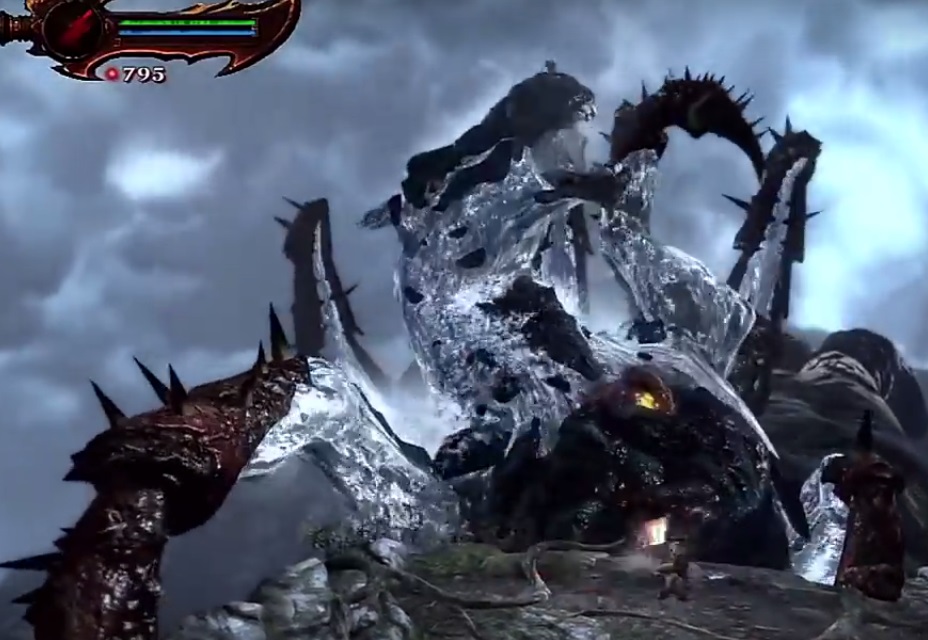
                                               POSEIDON CHARGING HIS TRIDENT


  • Attack redirection is also a mechanic that is heavily animation dependent. Attack redirection occurs when Kratos blocks an attack during a specific window of time to return the attack.
  • In addition, certain attacks and moves render Kratos and enemies vulnerable or stunned for brief periods. These are also primarily indicated through animations.
  • The game also uses invincibility frames where Kratos becomes invulnerable after receiving damage for a brief period. These are also primarily indicated through animations.

Decoding Epic Encounters in God of War


A cornerstone of the God of War series, is clearly creating large scale set pieces. I say set pieces because these encounters feel more like self contained mini experiences rather than traditional boss battles.

TECHNOLOGY
  • Centering the game around segments that don't necessarily fit within the modelling of moment to moment gameplay means that specialized tools needed to be developed for creation of these segments.
  • In GOW3 several boss battles take place on top of moving entities such as titans. During these encounters the characters respond dynamically to movements on the parent entity itself.
  • This infers the existence of a system where child objects of a particular joint respond to transform changes of the parent object.
  • However, these transform changes couldn't possibly be entirely systemic. A large amount of manual effort must have been involved in aligning attached entities during animation steps.

  • In addition, collision on attached entities must have also demanded intricate collision meshes to allow for battles to take place on the parent entity.

PACING
  • Each encounter typically has several different stages, with each stage having an epic cinematic payoff.
  • Sometimes an encounter can play out over the course of an entire level.
  • This affects pacing quite dramatically, as it allows for each stage to be consistently high octane with a tension release in between stages rather than during the battle.
  • It also allows for the opportunity to contextualize the encounter over time.
    Eg: Poseidon's encounter progresses from an attack on Kratos to an attack on Gaia placing Kratos' vehicle in jeopardy.


PROGRESS
  • Enemies don't have explicit health bars. Instead, what is made evident is how the beast can be defeated. This is also a means for players to gauge their progress in the battle.
    Eg: Kratos defeats Hades by literally cutting away pieces of him.

                                    
  • In addition most larger bosses also tend to have avatar changes over the different stages also indicating a sense of progress to the player. These avatars also help visualize the characters arcs of the bosses within the battle.

                                                     HADES REGULAR AVATAR                            


                                             HADES ANGRY AVATAR NEAR DEATH


ENCOUNTER INITIATION
  • Clearly a lot of effort goes into making each encounter feel unique.Nevertheless, certain characteristics of a classic God of War encounter are identifiable.
  • Encounters tend to begin at surprising moments without announcement.

                            HADES ATTEMPT TO RIP KRATOS' SOUL AT INITIATION


                                             POSEIDON'S SUDDEN EMERGENCE

PLAYER'S INITIAL REACTION

  • A player's initial reaction to boss' at this scale tend to be instant aggression. Therefore, typical first responses tend to be furious hammering of attacks at the boss.
  • To accommodate for this player behavior, bosses tend to begin by slowly paced similarly styled attacks.
  • These attacks tend to be agnostic of player position, making evasion fairly simple.
  • This stage could even be marked by diminished attack damage as the player will undoubtedly be hit a few times.

                 POSEIDON'S INITIAL UNI-DIMENSIONAL WATER BREATH ATTACK


    HADES' INITIAL UNI-DIMENSIONAL STOMP ATTACK

BUILDING IN NUANCE
  • Eventually the player deciphers the animation that maps to the boss's attack preparation and eventually learns to either block or evade the attack depending on blockability of the attack.
  • As the battle progresses, boss attacks tend to require more specific player evasive action.
  • There is almost a sense of puzzle solving involved in deciphering the required evasive action which could range from flying on impact, continuous rolling, rolling to a specific position etc.
  • This phase gets compounded by adding multiple attacks forcing the player to maintain an attack - evasion mapping in his mind.
  • This also causes players to attack from positions where they can realistically react in time to avoid impact.

                                HADES' EARTHQUAKE - REQUIRES PLAYER TO FLY


     POSEIDON'S PINCER ATTACK - REQUIRES PLAYER TO BE AT PLATFORM CENTER


PLAYER CHEATS

  • The game provides various means for the player to make himself invulnerable for brief periods. This includes magic attacks, rage of sparta mode, grabbing smaller enemies etc.
  • An element of meaningful choice that the player encounters is when he wishes to use these time bound 'cheat' resources.
  • However, the game occasionally invalidates these cheat strategies as well. For example, a boss strike could be longer than the invulnerability period of a magic attack.


    WHIRLWIND MAGIC - INVULNERABILITY SHORTER THAN POSEIDON TRIDENT

    EPIC PAYOFF MOMENTS
    • Boss encounters tend to be check pointed by payoff moments. The player hits circle to trigger a quick time sequence punctuating a visual cut scene.
    • These sequences tend to have the camera scale back to demonstrate the largeness of the encounter.

                                         CAMERA SCALE BACK MOMENT


INVALIDATING PLAYER SCHEMA
  • As mentioned above, encounters occur over several stages. One technique that the game utilizes is adding subtle variations on individual boss attacks in subsequent stages.
  • For example, an attack sequence that had two attacks might now have 4 instead.
  • This causes the player to actively resist moves that he has hopefully internalized at this point.

    HADES CHAIN ATTACK HAS 3 HITS INSTEAD OF 2 IN 2nd STAGE
                                 
ENCOUNTER FRAMING
  • Memorable GOW encounters don't always involve a boss. Sometimes waves of enemies can be just as engaging.
  • Simple things like how these encounters are framed can add pressure on the player.
  • For example, stating that 'wandering souls' need to be killed before they are converted into Hades army is so much more effective than simply dropping undead creatures.

FEEDBACK LOOPS
  • The game has a variety of types of beasts differentiated on various axes.
  • By combining different categories of beasts, the game builds in feedback loops making encounters easier or more difficult.
  • For example, a positive feedback loop occurs by adding grabbable characters. This gives the player breathing room to take a break from the action or evade attacks from other monsters.

                          
  • A negative feedback loop occurs when a combination of two monsters can deal greater damage. Eg : Medusa with other quick attacking characters can instantly kill Kratos by turning him into stone and then shattering him.

     
  • Another interesting component is that there exists triangular high risk, high reward built into the negative feedback loops.
  • For example, players can use Medusa's stone flash attack to turn into stone other monsters. This however, comes at the risk of Kratos being turned into stone himself.

Monday, February 20, 2017

Emotional Synchronization : A Trickle Down Design Pillar


In an article titled 'Designing Game Narrative', Terence Lee speaks quite disparagingly about story in Tomb Raider, and indeed most modern game narrative. It is ironic then to hear Jonathan Hamel, Tomb Raider Lead Systems Designer, discuss at GDC 2013 how emotional synchronization between the player and Lara was in fact the primary design goal for the multi-million dollar project. Furthermore he goes on to generalize that creating ludo-narrative resonance is a usable yardstick to evaluate how meaningful gameplay feels to the player. He even states the science behind this phenomenon. In a nutshell, Princeton reviewers found that in MRI scans with storytellers and listeners that have matching neural patterns as the story is being told, the odds of accurate recall in the listener greatly improves.


Nevertheless, this blog is not intended to dwell on the high level. Instead, I'd like to describe one development pillar in terms of how Hamel breaks down emotional synchronization as a goal into systems design. Additionally, I'd also like to evaluate my experience of playing the game compares to Hamel's claims. Broadly Hamel describes three systems categories for Tomb Raider.


DESPERATE COMBAT

TALK - The initial plan for Tomb Raider was to have a primarily ranged vs melee combat system, as in most previous games from the franchise.


However, the emotional goal for combat system was to feel engaged in a desperate struggle for survival. A melee vs ranged combat system entails a lot of backing away from incoming enemies. Not a very compelling system for players to feel engaged in a desperate struggle. Instead a ranged to ranged system was far more compelling way to elicit this emotional synchronization. This change in battle style caused the team to reevaluate fundamental thematic elements. Enemy types shifted from zombies to human squads in order to better fit ranged to ranged combat.


This then necessitated fluid cover systems, patrol type squad behavior etc. The design of the cover system itself was further influenced by emotional synchronization. In order to capitalize on player perception of Lara as a nimble agile character, the cover system was made non-sticky, which means she would automatically enter and exit cover without the  requirement of a button press.

ANALYSIS- The game does have both elements of charging and ranged enemies, with the balance working nicely for the most part. Charging enemies definitely do force the player backwards, however the effect is not necessarily as Hamel describes it. There is a sense of desperation involved trying to align the reticle and fire as the enemy charges in. There's also a element of decision making involved in when to stop aiming and instead use the roll away option. Once the roll is completed, there's also an element of desperation involved in trying to reorient and initiate fire before the enemy starts charging again.

It's also worth pointing out that this creates an unrealistic AI system that is perfectly justified due to the fact that it creates emotional synchronization. It's completely unrealistic for an enemy such as a wolf to charge, attack once and then back away simply to redo the process. Another thing worth pointing out is that charging enemies causes the player to switch weapons in order to quickly incapacitate the incoming enemy.

The drawback of the cover system is that it allows the player to camp and take out enemies from afar. Hamel describes the introduction of a melee system and enemies throwing explosives in order to mitigate this effect. However, neither of these systems really achieve their goal. this is probably a case of data balance, level design and incompatible health systems not doing enough with the created systems. Explosives don't obliterate cover points; they simply invalidate them for a given duration of time. Additionally, Lara doesn't take any damage while rolling creating a simple dominant strategy to roll from cover to cover. To cap things off, the health system is not HP based, it is regenerative (like Uncharted). This makes it easy to hold your weapon out and wait for a hiding enemy to enter range even at the cost of getting hit. If desperate combat was the goal it seems like a HP system (like The Last of Us) would have suited the system better.

In conclusion, it's worth reminding ourselves that this entire analysis trickles down from and supports the goal of maintaining synchronization between the character and player. Pretty neat huh?!

Sunday, February 19, 2017

Designing a New Dice Game - Snatch the Match


SNATCH THE MATCH - STARTING RULESET

  • The game is played with 4 dice and two players or more. Note that the game is most engaging with 4 players.
  • One player is also designated to track score through pen and paper. As each player scores during his/her turn, write down the cumulative score, not just the score for that turn. This will make it easier for the players to track their progress.
  • Phase 1 (First turn) : Video Link to Demonstration

    • Players start by tossing the dice and catching them on the back of their palms.
    • They then flip the dice they caught back in the air and catch them in their palms.
    • They place the caught die on the floor and multiply the numbers for their score.
  • Phase 2 : In subsequent turns, players roll all 4 dice.
  • If all 4 dice are even, then we have a ‘match’
    • When a match occurs based on any player’s roll, all players must snatch the dice!
    • Players multiply the numbers on the dice they successfully snatched and add them to their score.
    • All players who caught at least one dice now go back to Phase 1.
  • If all 4 dice are odd, then the added score of all 4 dice is subtracted from player score!
  • If 2 or 3 out of 4 dice are either odd or even then: Video Link to Demonstration


    • Player picks one die from the larger category, i,e, odd or even.
    • With his finger he flicks the die such that it hits another die of the same category.
    • The two numbers are added for the score.
    • After the first contact, if either die hits the other number in the category, then the score is multiplied by that number.
    • If any die hits the die from the other category then the score is 0.

PROBABILITY ANALYSIS

  • Probability of getting 2 out of 4 odd or even numbers :
    • 1(2^4) * 4C2 = ⅜
    • Thrice every two rounds for 4 players
  • Probability of getting 3 out of 4 odd or even numbers :
    • 1(2^4) * 4C1 = ¼
    • Once every round for 4 players
  • Probability of getting all odd or even numbers :
    • 1 / 2^4 = 1/16
    • Once every 4 rounds for a team of 4

GENERAL THOUGHTS

  • The game is definitely better suited to a younger demographic, probably in the age group of 10 - 15, primarily because fine motor skills are still developing but not yet undeveloped at this age.
  • The engagement factor in the physical elements of the game would probably be higher at a younger age as well.
  • I’m unsure on whether the game needs a theme. I don’t think it would any particular value to the mechanics.
  • The selection of 4 dice for the game draws from the game it was inspired by. When I considered changing the number of die, I realized that 4 is sort of a magic number for this game to work. It provides the perfect set of probability as well as symmetry.

PLAYTEST ANALYSIS AND CHANGES - ITERATION 1
Players - Group of 4 CMU friends (no affiliation to games and not avid gamers)
Date - Saturday 09:00pm, 4th February

  • Observation - The probability of an all even is too low. One of the key elements of engagement here is the ‘match’ element of the game and it is too infrequent.
    Change - A match is triggered when all even or all odd occurs. Therefore no subtraction of score occurs.
PLAYTEST ANALYSIS AND CHANGES - ITERATION 2
Players - Roommate
Date - Sunday 12:00pm, 5th February

  • Observation - The stakes of a turn are not high enough, i.e. players are not rewarded for a good performance in their turn.
    Change - A player’s turn continues until a mistake is made or a match occurs.
  • Observation - Players tend to reach for a match even when it hasn’t occurred.
    Change - If a player falsely reacts to a match, then he loses one turn.

PLAYTEST ANALYSIS AND CHANGES - ITERATION 3
Players - Game Design Group (4 ETC students)
Date - Sunday 07:00pm, 5th February

  • Observation - The game needs an end state! In my haste to ‘test the toy first’ I neglected the fact that players need an end state to track progress. The objective of the game is probably as important an engagement factor as the mechanics.
    Change - First player to 100 points wins. This also means we need to cap the multiplication rewards. In any stage no more than the scores of 2 dice may be multiplied.

PLAYTEST ANALYSIS AND CHANGES - ITERATION 4
Players - Jing Shu
Date - Tuesday 03:00pm, 7th February

  • Observation - A player’s turn could drag on endlessly. Additionally, once a player gets ahead in the game, it’s very difficult to catch upto him/her.
    Change - When a player successfully executes a turn, he has a choice on whether to play again or pass. If he loses his next turn, he forfeits all points earned in that turn.

    The hope here is that players will determine whether to pass or risk another turn, based on the state of the game, i.e. whether they are lagging behind or whether they are close to the finish line. It is worth pointing out that this is rule has the potential to greatly impact player mindset and the genesis of the rule came from the game’s objective, not it’s mechanic. This further underscores my belief that while it is important to ‘test the toy’ first, considering the mechanics in relation with the end goal is also important.

PLAYTEST ANALYSIS AND CHANGES - ITERATION 5
Players - Group of 4 CMU friends (no affiliation to games and not avid gamers)
Date - Wednesday 07:00pm, 8th February

  • Observation - After testing now with quite a few players, it is apparent that there is a clear disparity between players who have a certain degree of fine motor skill and those who don’t. The latter group disengages because it takes too long to clear Stage 1, i.e., throwing and catching the dice.
    Change - Players may choose to pass Stage 1 and directly proceed to rolling the dice. However, players who do so forfeit the ability to snatch other player’s matches.

PLAYTEST ANALYSIS AND CHANGES - ITERATION 6
Players - Roommate
Date - Thursday 09:00pm, 9th February

  • Observation - The game lacks an equalizing mechanic. Once a player gets ahead, there isn’t much holding him/her back.
    Change - 100 must be reached by an exact number, unless they cross the number through a snatch. Hopefully this will cause players to pay careful attention to what dice they are choosing to shoot and then even more carefully for a match. The goal with this rule was to emphasize the role of the match as well as create an equalizer.

PLAYTEST ANALYSIS AND CHANGES - ITERATION 7
Players - Just myself
Date - Friday 09:00pm, 10th February

  • Observation - The game has too many rules. It is unnecessary to differentiate between two odd/even and three odd/even numbers.
    Change - Remove multiplication bonus for three odd/even numbers. It’s overly complicated for no real reason. This leaves us with only two cases for each roll - match (multiplicative score) and no match (additive score).
  • Observation - The equalizing mechanism is not sufficient or particularly engaging. Moreover, the equalizing is independent of the performance of other players.
    Change - When a snatch occurs, players can choose to either add to their score or subtract from an opponent’s. This not only emphasizes the snatching, but also allows the players to equalize by a combination of skill and chance.

PLAYTEST ANALYSIS AND CHANGES - ITERATION 8
Players - Game Design Group
Date - Sunday 07:00pm, 12th February

  • Observation - The ending is boring. As in all games that impose the ‘must reach final destination with an exact number’ rule, it’s not particularly fun sitting around waiting for a needed configuration.
    Change - Player moves backwards based on the exceeded score. For example, if the player is at 94 and the score is 8, then his score becomes 98 (94 + 8 = 102 - 100 = 98). This also means that the player’s turn continues until he misses, thereby giving him a stake in the end state based on skill.
  • Observation - Game win condition is slightly unclear. Suppose a player snatches successfully and his score crosses 100. Does he win even if other players have snatched and choose to subtract the player’s score instead of adding to their own?
    Change - The player wins only if his score exceeds 100 after all deductions. This makes the snatch important and adds an element of randomness to the snatch win condition. For example, if a player is at 95 and he successfully snatches 2 dice, while both the other players snatch one each. The odds of his multiplied dice - added score of other player’s dice is still heavily chance driven.

FINAL RULESET

  • The game is played with 4 dice and two players or more. Note that the game is most engaging with 4 players.
  • One player is also designated to track score through pen and paper. As each player scores during his/her turn, write down the cumulative score, not just the score for that turn. This will make it easier for the players to track their progress.
  • Phase 1 (First turn) : Video Link to Demonstration

    • Players start by tossing the dice and catching them on the back of their palms.
    • They then flip the dice they caught back in the air and catch them in their palms.
    • They place the caught die on the floor and multiply the numbers for their score.
  • Phase 2 : In subsequent turns, players roll all 4 dice.
  • If all 4 dice are even or odd, then we have a ‘match’
    • When a match occurs based on any player’s roll, all players must snatch the dice!
    • Players multiply the numbers on the dice they successfully snatched and add them to their score.
    • All players now go back to Phase 1.
  • If there is no match : Video Link to Demonstration


    • Player picks one die from the larger category, i,e, odd or even.
    • With his finger he flicks the die such that it hits another die of the same category.
    • The two numbers are added for the score.
    • If any die hits the die from the other category then the score is 0.
    • Player may choose to continue playing and add their score. However, if they miss or a match occurs their score for the entire round is 0.

WIN STATE

  • 100 must be reached by an exact number, unless they cross the number through a snatch.
  • Player moves backwards based on the exceeded score. For example, if the player is at 94 and the score is 8, then his score becomes 98 (94 + 8 = 102 - 100 = 98).
  • The player wins only if his score exceeds 100 after all deductions.